
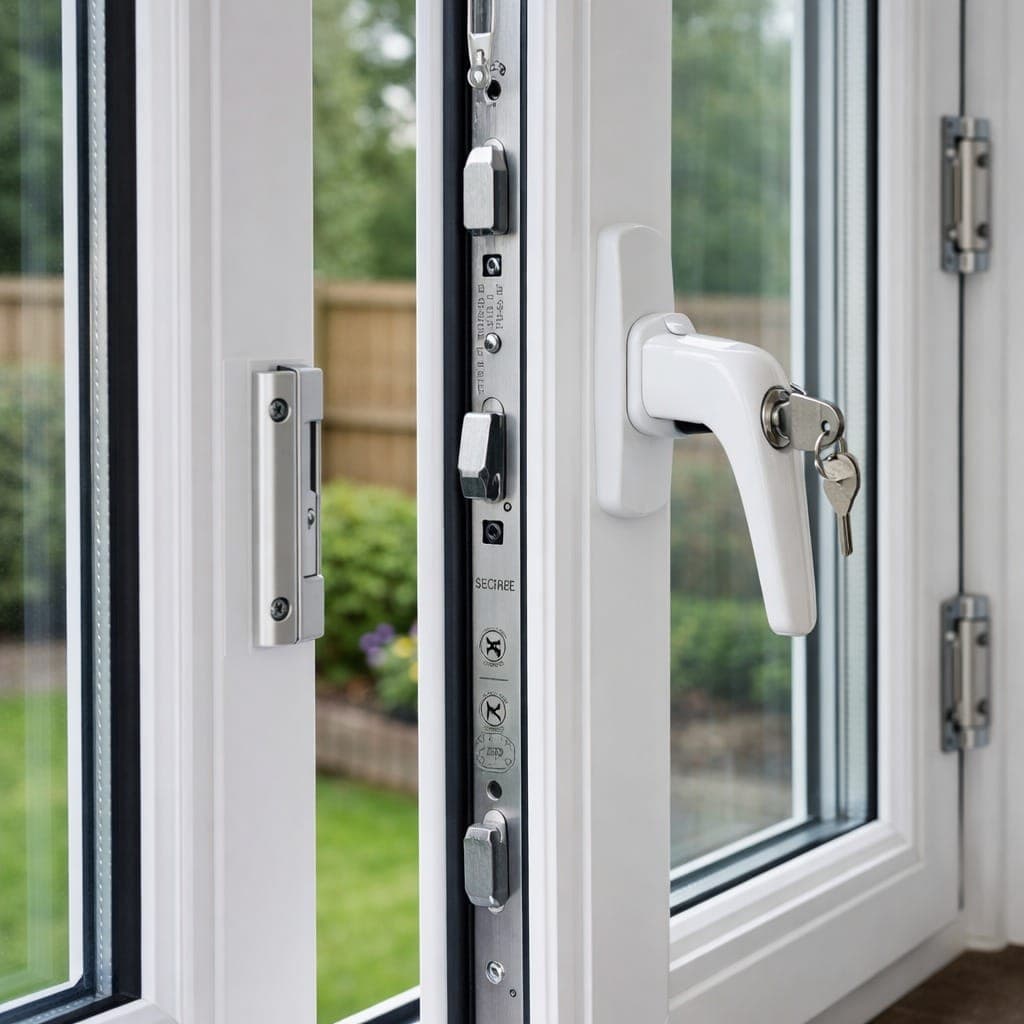
How to Compare uPVC Window Profiles, Steel Reinforcement, Glass and Hardware
Two uPVC window quotations can look similar while specifying different materials and components. Learn how to compare profiles, reinforcement, glass, hardware, seals and installation details before choosing a supplier.
When you compare uPVC window quotations, it is tempting to focus on the total price, the colour of the frame or the number of tracks. Those details matter, but they do not tell you everything about the window you are buying.
A window is a complete assembly. Its performance depends on the frame profile, reinforcement where required, glass specification, locks and operating hardware, gaskets, drainage design, fabrication quality and installation. Two quotations may both say "white uPVC sliding window" while describing different combinations of these components.
If you are planning new windows or replacing old aluminium windows in Chennai, ask each supplier to specify what is included. You do not need to become a window engineer. You need enough information to compare like with like.
This guide explains what to check, which questions to ask and how to compare quotations without relying on vague claims such as "premium quality" or "best profile".
Quick comparison: what should you check?
| Component | What to verify | Why it matters |
|---|---|---|
| uPVC profile | Profile system, series, configuration and compatible hardware | Influences frame design, sash arrangement and system compatibility |
| Steel reinforcement | Where reinforcement is specified, its section and thickness, and how it is installed | Helps the assembly resist loads and keep its shape when designed and fitted correctly |
| Glass | Type, thickness, pane arrangement and any safety or acoustic requirement | Affects safety, daylight, privacy, heat transfer and noise |
| Hardware | Locking points, handles, hinges or rollers, and serviceability | Affects day-to-day operation, security and maintenance |
| Gaskets and seals | Seal arrangement and material specified by the system | Helps limit air, dust and water entry when correctly designed and installed |
| Drainage | Weep holes and drainage paths appropriate to the system | Helps water leave the frame rather than collect in it |
| Fabrication and installation | Measurements, fixing, perimeter sealing and final operation checks | Even good components can perform poorly if fabrication or installation is wrong |
| Written quotation | Itemised scope, sizes, exclusions, warranty and service terms | Makes competing quotations easier to compare fairly |
1. Start with the actual window design
Before comparing brands or materials, make sure each supplier is quoting for the same design. A two-track sliding window, a casement window and a fixed window do not operate in the same way. Even two sliding windows can differ in the number of shutters, track arrangement, mesh provision, opening size and hardware.
Record the following for every opening:
- Room and location, such as bedroom, kitchen or balcony
- Width and height measured at the site
- Window type and number of shutters
- Fixed and openable sections
- Mesh requirement
- Glass requirement
- Colour and finish
- Any access, safety or building-association restrictions
Ask whether the quoted dimensions are preliminary or based on a final site measurement. Final manufacturing dimensions should be confirmed through the supplier's measurement process rather than guessed from a rough wall opening. Our measurement guidelines show how openings are measured.
For design ideas, explore our uPVC sliding windows and uPVC casement windows. If you are still choosing between the two styles, our casement vs sliding comparison covers where each one works best. Confirm the exact model and configuration with the supplier before ordering.
2. Understand the uPVC profile system
The profile is the shaped uPVC section used to build the window frame and opening sash. Different systems have different geometries, chamber arrangements, wall sections, reinforcement provisions, compatible hardware and size limits.
What to ask about a profile
Ask the supplier to identify:
- 1Profile brand and series: the actual system or series name, not only phrases such as "German technology" or "premium profile".
- 2Frame and sash configuration: the frame, sash, mullion and coupling pieces should suit the selected design and opening size.
- 3System compatibility: whether the selected hardware, gaskets, reinforcement and glazing arrangement are intended for that profile system.
- 4Published technical information: relevant technical sheets or test documentation, when particular performance claims matter to your project.
- 5Availability of replacement parts: how compatible hardware or seals can be obtained if service is needed later.
Does a thicker or wider profile always mean a better window?
Not necessarily. Profile dimensions alone do not prove overall performance. The correct profile depends on the window type, dimensions, loads, glass weight, hardware and system design.
Likewise, chamber count alone is not enough to rank two windows. Ask for the profile series and the full specification of the assembled window, then compare the information relevant to your opening.
What about the profile brand?
A recognised brand helps you identify a system and request its technical information, but the brand name by itself does not tell you whether the right profile, reinforcement, glass and hardware have been selected for your particular window.
Sunlight builds windows with SAF Baydee and Prominance profiles, and our Basic, Premium and Elite series differ in profile, hardware and glazing. So ask for the exact series and configuration in your quotation rather than assuming every range uses the same components.
3. Check the steel reinforcement specification
Some uPVC window systems use metal reinforcement within specified frame or sash sections. Its role is to help the assembly meet structural and operational requirements. The reinforcement required depends on the system, window dimensions, design, loads and manufacturer guidance.
Do not rely only on a verbal assurance that "steel is included". Ask:
- Which frame, sash or mullion sections require reinforcement for this design?
- What reinforcement section and thickness are specified?
- Is the reinforcement galvanised or otherwise protected as specified for the system?
- How is it secured within the profile?
- Is the reinforcement suitable for the window dimensions and glass weight?
- Can the supplier show the relevant specification or manufacturing details?
The answer should be based on the selected system and the actual window design. There is no single reinforcement size that is correct for every uPVC window.
Why the specification matters
An incorrectly specified or installed assembly can have difficulty keeping its alignment or operating as intended. Reinforcement is one part of the design; it does not make up for unsuitable profiles, poor fabrication, incorrect hardware or inadequate fixing to the building.
4. Compare glass by specification, not just appearance
Glass affects more than how transparent a window looks. Depending on the glass and the complete window system, it can influence safety, privacy, daylight, solar heat gain, thermal insulation and noise reduction. The right option depends on the room, orientation, outside noise, safety needs and budget.
Glass options to discuss
| Glass option | Common reason to consider it | What to confirm |
|---|---|---|
| Clear glass | Maximising a clear view and natural daylight | Thickness, pane size and suitability for the location |
| Tinted glass | Managing glare or changing the appearance of incoming light | Visible-light transmission, solar properties and colour effect |
| Patterned or obscure glass | Privacy in bathrooms or other overlooked spaces | Privacy level, light transmission and cleaning requirements |
| Toughened safety glass | Locations where safety glazing is required or specified | Applicable safety requirements, markings and correct use |
| Laminated glass | Some safety, security or acoustic applications | Glass make-up, interlayer and evidence for the intended performance |
| Double glazing | Improving thermal or acoustic performance in a suitable system | Both panes, cavity width, spacer and seal construction, and whole-window compatibility |
These are general descriptions, not a substitute for project-specific advice. The right glass depends on dimensions, support, location and relevant safety requirements, so ask a qualified supplier to confirm the specification for your opening. Our guide to choosing glass for uPVC windows covers each option in more detail.
Does double glazing always make sense in Chennai?
Not automatically. Double glazing may be useful when the project has particular thermal or acoustic goals, but its value depends on the glass configuration, frame and seals, orientation, outside conditions and budget. Our guide on when double glazing pays off goes through those trade-offs.
For a noisy road-facing bedroom, discuss the noise source and the complete window assembly rather than asking only for "soundproof glass". For a sun-exposed room, ask about solar heat gain and glare as well as visible light; our explainer on what a U-value tells you helps with those figures. If privacy is the main concern, patterned or other privacy glass may be more relevant.
Ask for the glass details in writing
The quotation should state the type and thickness of the glass, and any multi-pane construction or special performance requirement. If a supplier quotes a noise, safety or energy figure, ask for documentation showing what was tested and whether the figure applies to the glass alone or the complete window.
5. Inspect the operating hardware
Hardware includes the parts used to open, close, secure and support the window. The components differ by window style:
- Sliding windows: rollers, tracks, handles and locking mechanisms
- Casement windows: hinges or friction stays, handles and locking mechanisms
- Other configurations: hardware suited to the specific opening style
For sliding windows
Ask about the roller arrangement, access for cleaning the tracks, the locking mechanism and the availability of replacement parts. A sliding shutter should move smoothly without excessive force, unusual scraping or obvious misalignment.
For casement windows
Ask about the hinge or friction-stay specification, handle operation and locking arrangement. The sash should open and close without binding and sit evenly against the seals when closed.
For all window types
Check whether the hardware is identified in the quotation. Ask about its finish, maintenance needs, warranty coverage and service availability. A generic line such as "standard hardware" makes it difficult to know what is being supplied.
A higher number of locking points is not, by itself, proof that a complete window is more secure. Security depends on the whole assembly, including the frame, sash, glass, locks, fixing and installation. Our article on multi-point locking explains what extra locking points do and do not add.
6. Ask about gaskets, seals and drainage
Seals close the gaps between the frame, sash and glass. Their design and condition influence resistance to air, dust and water. Drainage paths let water that enters designated parts of the system escape safely. Ask the supplier:
- Which gasket or seal arrangement is used for this system?
- Are the seals compatible with the selected profile and glazing?
- How does the window drain water?
- Where are the drainage outlets, and will installation leave them unobstructed?
- What routine cleaning and maintenance are recommended?
A window should not be judged only by the number of seals or a label such as "weatherproof". Ask how the complete system is designed and what test evidence supports any specific water, air or wind performance claim.
After installation, inspect the frame and drainage outlets as part of the handover, and never block drainage openings with sealant or other materials. Our maintenance guidelines cover keeping seals and drainage clear over time.
7. Do not overlook fabrication and installation
The window delivered to your home is the result of a process, not just a list of materials. Accurate measurement, correct cutting and joining, appropriate glazing, hardware adjustment, fixing and perimeter sealing all matter. Before placing an order, ask how the supplier handles:
- Final site measurement and confirmation of opening dimensions
- Written approval of the window schedule and design
- Fabrication tolerances and quality checks
- Delivery and protection of finished windows
- Fixing to the building opening
- Perimeter sealing and finishing
- Operation checks and handover
- Warranty claims and after-sales service
At handover, operate each shutter, check that locks engage correctly, inspect the perimeter finish and confirm that drainage paths are clear. Raise any sticking, visible damage, unfinished gaps or locking issues before signing off the work. Our site specification guidelines list what the opening needs before installation and what to check afterwards.
For homes in Chennai, also discuss the actual site conditions: exposure to driving rain, wind, dust and coastal air, the building's height and the condition of existing openings. A suitable specification for one property may not suit another. Our guide to windows for coastal climates covers exposed sites.
8. Compare two quotations fairly
A low total price may reflect a different scope, and a high total price does not automatically guarantee better performance. Compare the specifications line by line.
| Item | Quotation A | Quotation B |
|---|---|---|
| Window schedule and final dimensions | Confirmed / Missing | Confirmed / Missing |
| Profile brand and series | Specified / Unclear | Specified / Unclear |
| Frame, sash and mullion configuration | Specified / Unclear | Specified / Unclear |
| Reinforcement details where required | Specified / Unclear | Specified / Unclear |
| Glass type and thickness | Specified / Unclear | Specified / Unclear |
| Hardware and locking system | Specified / Unclear | Specified / Unclear |
| Gaskets, seals and drainage | Specified / Unclear | Specified / Unclear |
| Mesh and accessories | Included / Extra / Not applicable | Included / Extra / Not applicable |
| Installation and finishing | Included / Excluded / Unclear | Included / Excluded / Unclear |
| Removal or disposal of old windows | Included / Excluded / Unclear | Included / Excluded / Unclear |
| Taxes, transport and other charges | Clear / Unclear | Clear / Unclear |
| Warranty and service terms | Written / Unclear | Written / Unclear |
| Final total and payment milestones | Clear / Unclear | Clear / Unclear |
Do not assume a component is included just because some manufacturers normally supply it. If one quote is cheaper, ask the supplier to explain the differences, and compare the same number of windows, the same dimensions, the same glass and hardware, and the same installation scope before deciding. For the cost side of the comparison, see our guide to uPVC window prices in Chennai.
9. Common mistakes to avoid
Choosing by profile brand alone
A profile brand is only one part of the assembly. Compare the actual system, reinforcement where required, glass, hardware, fabrication and installation.
Assuming more chambers means better performance
Chamber count is not a complete performance rating. Ask for the relevant system details and evidence for any performance claims.
Accepting "premium glass" without a specification
Ask for the glass type, thickness and construction in writing. If acoustic, solar or safety performance is important, ask for evidence that matches the intended use.
Treating a warranty as a substitute for specifications
A warranty matters, but you should still know what is being supplied, what is covered, what is excluded and how service requests are handled.
Comparing only the price per square foot
Price per square foot can be useful as a rough first comparison, but it can hide differences in window type, opening configuration, glass, hardware, mesh, reinforcement, installation and finishing. Compare the complete itemised scope.
Forgetting to inspect the installed windows
Check movement, locking, visible damage, perimeter finishing and drainage at handover. Report issues promptly and keep the approved quotation and warranty documents.
10. Questions to ask your uPVC window supplier
Take these questions to your site visit or quotation discussion:
- 1Which profile brand and series are included in this quote?
- 2What is the exact window configuration for each opening?
- 3Where is reinforcement required for this design, and what is specified?
- 4What glass type and thickness are included?
- 5Which rollers, hinges, handles and locks are included?
- 6What seal and drainage arrangement does the system use?
- 7Are mosquito mesh, grills, removal of old windows and finishing included?
- 8Will you take final measurements before manufacturing?
- 9What installation work is included, and what is excluded?
- 10What are the warranty terms for profiles, hardware, glass and installation?
- 11What documents will I receive at handover?
- 12Who should I contact if a shutter needs adjustment or service?
A professional supplier should be able to explain the proposed specification clearly and identify the items that still need to be confirmed.
Frequently Asked Questions
Short answers to the questions homeowners ask most often when comparing uPVC window specifications.
There is no single component that determines the quality of every window. The profile, reinforcement where required, glass, hardware, seals, fabrication and installation work together. Start with the requirements of the opening and compare the complete specification.
No. Profile dimensions alone do not establish performance. Suitability depends on the system design, window size, glass, hardware, loads and installation. Ask for the actual profile series and the relevant technical details.
Reinforcement requirements depend on the profile system, dimensions, design and loads. Ask the supplier to specify where reinforcement is required for your particular windows and how it is installed.
That depends on the location, dimensions, safety requirements, security goals and acoustic needs. Ask the supplier to assess the opening and specify suitable glass, rather than choosing from a general online rule.
No. It may help with particular thermal or acoustic goals, but it is not automatically the best value for every room. Consider orientation, outside noise, glass specification, frame and seals, and budget together.
Compare the same dimensions and window designs, then check the profile, reinforcement, glass, hardware, seals, mesh, installation, finishing, taxes and warranty. Ask for written clarification of every item marked "standard" or left unspecified.
Operate each shutter, test the locks, inspect the visible frame and glass, review the perimeter finish and make sure the drainage outlets are clear. Record any issues and ask the installer to fix them before final handover.
Ask what was tested, which configuration was tested, who performed the test and whether the result applies to the complete window or only one component. Do not compare figures that measure different things.
Conclusion: compare the complete window, not just the label
A good uPVC window decision starts with a clear requirement and a complete written specification. Confirm the profile system, reinforcement where required, glass, hardware, seals, drainage and installation scope. Then compare quotations on the same basis.
This approach shows you what you are paying for, helps you ask better questions and keeps you from choosing on a brand name or headline price alone.
Need help discussing your window requirements?
If you are planning windows for a home in Chennai, share your window types, approximate sizes and priorities, so the recommendation can be based on your actual openings.
Ask our team which profile series, glass and hardware we would propose for each opening, and what each quotation line includes.
Bring your opening sizes and the questions above to a site visit or quotation discussion.
- Phone+91 98418 19576
- ShowroomSR Plaza, 2nd Floor, No. 96, Velachery Main Road, Sembakkam, Chennai 600 073
- FactoryPlot No. 41/42, Premier Avenue, Keelpadappai, Padappai, Chennai 601 301
Have a question this article did not cover? Get in touch — we will get back within a working day.
Continue reading
 Buying Guide
uPVC Window Prices in Chennai: What Determines the Final Quote?
Understand what affects uPVC window prices in Chennai, from dimensions and profiles to glass, hardware, mesh and installation. Learn what to compare in a quotation.
Read article Buying Guide
Single vs Double Glazing: When the Upgrade Pays Off
Double glazing costs about 35 to 45 percent more than single glazing on the same frame. Here is when it earns that money back, and when single glazing is genuinely fine.
Read article Technical
Multi-Point Locking and What It Adds to Window Security
Most home break-ins through windows happen because of single point locks, not because the glass was forced. Here is how multi-point locking works and why it is worth the upgrade.
Read article